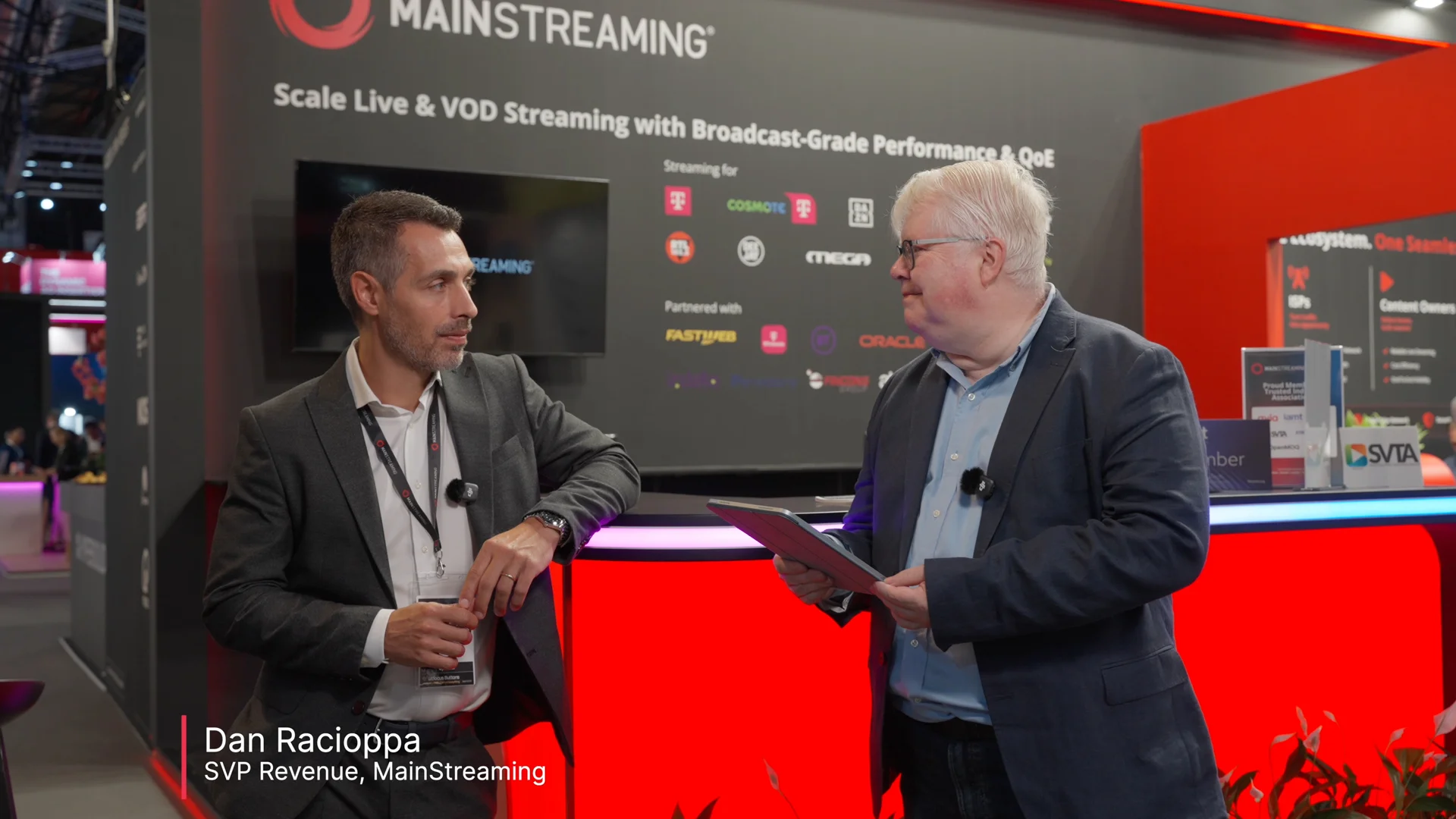
At IBC2026 in Amsterdam, Dan Racioppa, SVP Revenue at MainStreaming, and Saher Salam of Deutsche Telekom joined an SCTE panel on the technologies that will carry television fully onto the internet, and on why the industry will only get there by working together.
Television is no longer defined by a single way of reaching the screen. Linear broadcast was first joined by on-demand streaming; the next step is television delivered entirely over the internet. That shift, and what it demands from networks, was the focus of a panel hosted by SCTE – The Society of Broadband Engineers at IBC2026.
Moderated by Ian Nock, Vice Chair Publications & Marketing at SCTE, the session brought together Dan Racioppa and Saher Salam, with Xavier Leclercq, Chief Strategy and Partnership Officer at Broadpeak, and Emma Whitmore, SVP EMEA at Agami.
Not if, but when
Every market is somewhere on the path to internet-delivered television, whether it recognises it or not. The open questions are how quickly the transition will happen, and whether it will ever be complete or settle into a lasting mix of broadcast and streaming.
The UK offers the clearest signal so far. Its Green Paper, Watch this Space, published in June 2026, sets out two possible dates for switching off digital terrestrial television: the end of 2034, or a time-limited extension to 2044. The consultation closed at the end of August, and the final timeline will depend on the responses received.
For public service broadcasting, this makes the UK a first mover. Other markets will move at their own pace, shaped by the alternatives they already have in place, such as pay-TV cable networks.
Resilience starts with collaboration
Technology alone will not complete the transition, and this is where the partnership between MainStreaming and Deutsche Telekom came into the conversation.
Deutsche Telekom's priority is clear: to be resilient and to give its customers the best possible service, however large the audience. To achieve this, it is working with MainStreaming, with Deutsche Telekom providing the connectivity layer and our team contributing the technology and delivery stack.
This is our Better Together approach in practice. By deploying video delivery capacity directly within ISP networks, broadcasters gain predictable performance and the ability to scale live events with confidence. Operators, in turn, reduce pressure on their core networks and take an active role in delivering premium streaming experiences.
The Live Streaming on Demand (LSOD) platform we have built with Deutsche Telekom is a concrete example. It provides on-net capacity that can be activated when it is needed, so broadcasters and content owners can handle high-peak live events without overprovisioning for occasional spikes. It builds on our experience of delivering MagentaTV inside Deutsche Telekom's network, and shows how operators and technology providers can share responsibility for the viewing experience rather than managing their own part of the chain in isolation.
From big media to creators
The panel also looked further ahead. Viewing is shifting away from as-live delivery towards TV everywhere and on demand, while audience attention is increasingly shared between big media and creator-led social content. Networks will need to cope with more formats, more sources and less predictable peaks.
That makes collaboration even more important. No single broadcaster, operator or technology provider can guarantee the viewing experience end to end. When they align around shared objectives, internet-delivered television can match broadcast for reliability and go beyond it for flexibility and reach.