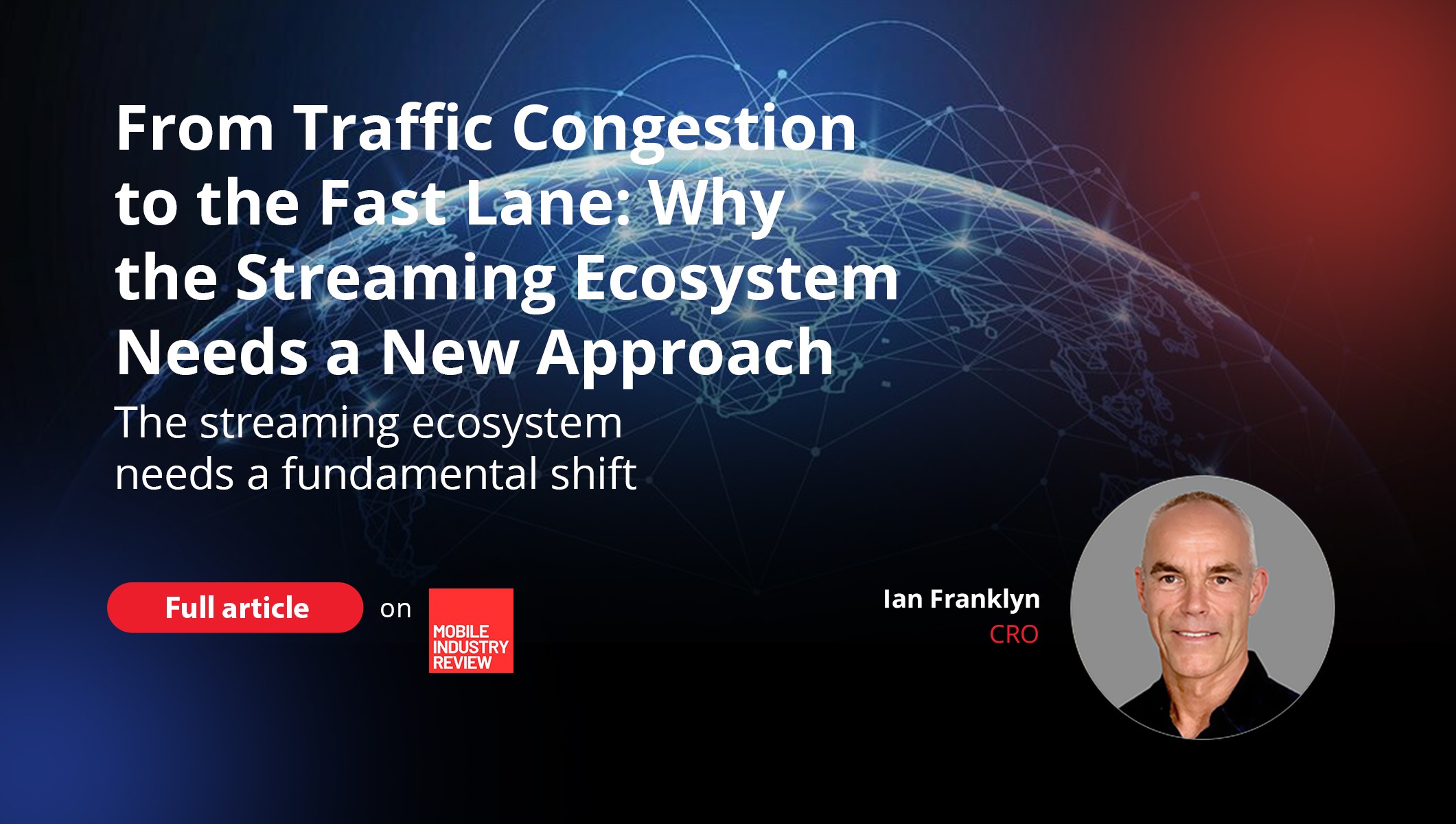
Ian Franklyn, our Chief Revenue Officer, has been featured in Mobile Industry Review, where he explores a critical shift reshaping the streaming industry: the urgent need for a more collaborative, ecosystem-driven approach to video delivery.
In his thought leadership article, Ian highlights how the rapid growth of streaming traffic is pushing existing delivery models to their limits, and why the future of streaming depends on moving from isolated approaches to true industry collaboration.
The Growing Pressure of Video Traffic on Networks
Video has become the dominant force on the internet, accounting for an ever-increasing share of global traffic. As consumption continues to rise, driven by live events, on-demand platforms, and new viewing habits, ISPs are carrying an unprecedented load.
This surge is not just a matter of scale, but of unpredictability. Traffic peaks during major live events can create sudden congestion, placing enormous pressure on network infrastructure and making it increasingly difficult for operators to maintain consistent performance. As a result, traditional delivery models, where each stakeholder operates independently, are no longer sufficient to handle the complexity and intensity of modern streaming demand.
Why the Current Model Is No Longer Sustainable
A key point raised in the article is that the current streaming ecosystem is structurally misaligned. Content providers, CDNs, and network operators often operate in silos, each optimizing for their own performance and economics rather than for the system as a whole.
This fragmentation leads to inefficiencies across the value chain. ISPs are left managing massive volumes of video traffic without direct control over how it is delivered, while content providers remain dependent on infrastructure that was not designed to support today’s scale and performance expectations.
As streaming continues to grow, this disconnect becomes more visible, resulting in higher costs, increased congestion, and inconsistent Quality of Experience for end users.
A Shift Toward a Collaborative Ecosystem
Ian’s perspective centers on a fundamental shift: moving from a fragmented model to a collaborative ecosystem where all stakeholders work together toward a shared objective, delivering the best possible viewing experience.
This means rethinking how value is created and distributed across the streaming chain. Rather than treating networks as a passive layer, ISPs can become active participants in content delivery, working more closely with technology providers and content platforms to manage traffic more efficiently and improve performance outcomes.
Collaboration, in this context, is not just a technical adjustment but a strategic transformation. It aligns incentives across the ecosystem, enabling each player to contribute to and benefit from a more efficient and scalable delivery model.
Unlocking the Fast Lane for Streaming
The article frames collaboration as the key to unlocking what Ian describes as the “fast lane” for streaming. In this model, video delivery is no longer constrained by fragmented infrastructure and competing priorities, but instead optimized through coordinated action across the ecosystem.
This results in more predictable performance, improved scalability, and a consistently high Quality of Experience for viewers, even during peak demand.
As streaming continues to evolve, the industry faces a clear choice: continue operating within siloed models that struggle to keep up with demand, or embrace a more integrated, partnership-driven approach.
Ian’s perspective makes it clear that the future lies in collaboration. By aligning technology, networks, and business models, the streaming ecosystem can move beyond congestion and inefficiency, toward a more sustainable and high-performing future.
Read the full article in Mobile Industry Review >